Introduction
At the global level, subsidies to the fishing industry were an estimated USD 35.4 billion in 2018, of which around 63% was provided in forms to enhance fishing capacity (Sumaila et al., 2019). These subsidies may reduce the cost of fishing and enhance revenue, which can contribute to the buildup of excess fishing capacity, overcapacity, and, ultimately, the depletion of fish stocks (see e.g., Clark et al., 2005). Nearly 90% of the world’s marine fish stocks are fully exploited, overexploited, or depleted (FAO, 2018), which indicates that existing fishing capacity exceeds what is necessary to harvest at the desired optimum yields. Excess capacity occurs when the amount of fishing capital is greater than the minimum amount required to harvest a given fish stock at the least cost (Gréboval, 1999). This problem is particularly serious in open access or common pool fisheries with ill-defined property rights (Kirkley et al., 2003; Pascoe et al., 2012). Such fisheries create an environment where the race to fish leads to inefficient or excessive capital investment (Emery et al., 2014). Excess capacity results in economic waste and makes harvest levels difficult to manage or control, which then leads to overfishing and stock depletion (Clark, 2007).
Since the mid-1990s, the government of Vietnam has made strenuous efforts to develop its offshore fisheries, and subsidy programs—such as the investment program for offshore vessels (in 1997 and 2014) and fuel cost compensation subsidies (in 2008 and 2011)—were introduced (see Duy et al., 2015; Pham et al., 2021). These subsidies have encouraged the growth of underdeveloped offshore fisheries with the expansion of the fleets and an increase in production. Vietnam introduced its offshore fisheries development program for several reasons. The first was to reduce the pressure on coastal fisheries resources and enhance income, create new jobs, and improve the living standards of fishing communities (Long et al., 2008). Second, the Vietnamese Exclusive Economic Zone (EEZ), which is part of the South China Sea (SCS), is abundant in marine resources, but it is currently under-exploited, with its maximum sustainable yield estimated at about 1.1 million tons (see, e.g., Duy et al., 2015; Long, 2009b). Moreover, given the international fishing disputes in the SCS and the lack of an internationally recognized delineation of the sea, the government also wanted to encourage the presence of its country’s own vessels in these areas (see, e.g., Long, 2009b). Theoretically, it could be argued that the distribution of natural resources in the coming period will be dependent on the agents’ extraction of that resource in the past; if future agreements on the SCS’s EEZs and fish shares among countries are based on track records, it may make sense for Vietnam to increase its historic share through the use of subsidies. Such investment may create a better future bargaining position when history-dependent allocations in quantity regulation may be expected (see e.g., Long, 2009a, 2009b; Long & Flaaten, 2011).
The SCS fisheries are still open-access resources for offshore fishing vessels from more than ten countries, including Vietnam. Vietnamese policies expanding fishing capacity may, however, lead to excess fishing capacity in offshore fishing fleets. Sustainable development in renewable natural resource industries, such as fisheries, is necessarily built upon sustainable exploitation resources at a target catch level, in which productive capacity matches the target sustainable yields from the resource stock. In practice, however, policies expanding fishing capacity in the sea area that lack an internationally recognized delineation may overlook, or be unaware of, the target yields, which would allow excess fishing capacity to form in open-access fisheries. Assessing fishing capacity in this open-access offshore fishing fleet in the SCS is important, especially in the context of the World Trade Organization (WTO) agreement on fisheries subsidies (IISD, 2021).
Khanh Hoa lies on the coast of Southern Central Vietnam in the SCS region. It covers an area of 5197.5 km2 with a coastline of 520 km and includes over 200 islands. In 2016, Khanh Hoa contained 303 offshore handline vessels (Duc, 2021). This fishing fleet is mainly found in Vinh Tho, Vinh Phuoc and Xuong Huan districts in Nha Trang City. Most fishers have good fishing experience, and they often come from traditional fishing households. The handline tuna fishing grounds are partly in Vietnam’s EEZ and partly in the disputed areas in the SCS. Fishing takes place all year round, from October to September of the following year, and is divided into two fishing seasons: the northeast monsoon (October to March) and the southwest monsoon (April to September). Offshore vessels often stay onshore for repairs and maintenance from either August to September or September to October. For the handline fishery, yellow fin tuna (Thunnus albacares) and bigeye tuna (Thunnus obesus) are the main target species caught, while small quantities of other species are referred to as by-catch (Duc, 2021).
Fishing capacity is the maximum amount of fish that a fishing fleet can reasonably expect to catch or land during the course of a year under normal and realistic operating conditions for each vessel, making full use of the machinery and equipment in place, and given the technology, availability and skill of skippers and crew, the abundance of the stocks of fish, some or all fishery regulations, and other relevant constraints (Joseph et al., 2008). Fishing vessel capacity based on this notion of physical output has primarily been estimated with data envelopment analysis (DEA), a method that uses linear programming techniques. Most papers adopting the DEA method for fishing capacity analysis have used the ray capacity measure (see, e.g., Cao et al., 2021; Kirkley et al., 2003; Nga et al., 2020; Pham et al., 2014).
In the case of multiple species or products, however, fishers might concentrate their efforts on high-value or specific target species. Because the precautionary approach is important to sustainable fisheries management (FAO, 1995), it is also important to investigate the partial capacity measure, which indicates how much the production of one output can be increased while keeping the other outputs fixed, as a reference point for fisheries management. These will help reduce the risk to fishery resources. Following Vestergaard et al. (2003), this study also adopts partial capacity measures for each species to provide a reference point for fisheries management.
Although one of the main advantages of DEA is its ease in dealing with multi-outputs, few studies have computed fishing capacity estimates for a particular species within a multispecies framework (for a review, see Solís et al., 2015). This paper adopts the DEA method to analyze fishing capacity of the multi-species Khanh Hoa handline fishery in the context of the WTO agreement on subsidies for fisheries. The effect of a fuel subsidy on the operational performance of small and large vessels will be examined, because this subsidy program is based on engine size. The species-specific capacity measures for yellow fin tuna and big eye tuna in handline fishing fleet are calculated. The rest of this paper is organized as follows: Section 2 discusses the major issues in measuring and analyzing fishing capacity in fisheries; Section 3 discusses the methodology used to estimate fishing capacity and related capacity measures; Section 4 discusses Vietnam’s handline fishery in the SCS and the data used for the analysis; Section 5 presents capacity estimation and analysis; and Section 6 provides a summary and conclusions.
Materials and Methods
Fishing capacity (i.e., capacity output) is defined as the maximum quantity of fish that can be produced in a specified period by a vessel or a fleet given a set of fixed inputs (capital utilized), existing fish biomass, and applicable fishing regulations but in the absence of variable input constraints (FAO, 1999). This is a short-term concept, as fishers face constraints in terms of the resource stock and their use of fixed inputs. The capacity of a vessel can also be defined as the maximum level of output that it could be expected to produce under normal working conditions (Pascoe et al., 2003). Hence, capacity output considers periods of maintenance, poor weather, seasonal factors, and other normal breaks in activity.
The capacity utilization (CU) of a fishing vessel is the degree to which the vessel is achieving its capacity output given its physical characteristics (i.e., fixed inputs such as hull length and/or engine power). CU is computed as the ratio of observed output (y) to capacity output (yC)—that is, CU=y/yC (Morrison, 1985). A CU less than one indicates that fishing vessels have the potential for greater production without having to incur expenditures for new capital.
Next, the unused capacity output of a fishing vessel is (1 – CU)×yC; and the unused capacity is 1 – CU. There are two sources of the unused capacity output for a fishing vessel (see Pascoe & Tingley, 2007): the first is that a fisher might fail to produce the technically efficient level of output for a given set of inputs (both fixed and variable); and the second is underutilization of fixed inputs (i.e., fishing capacity underutilization) due to variable input limitations. The two concepts are illustrated in Fig. 1.
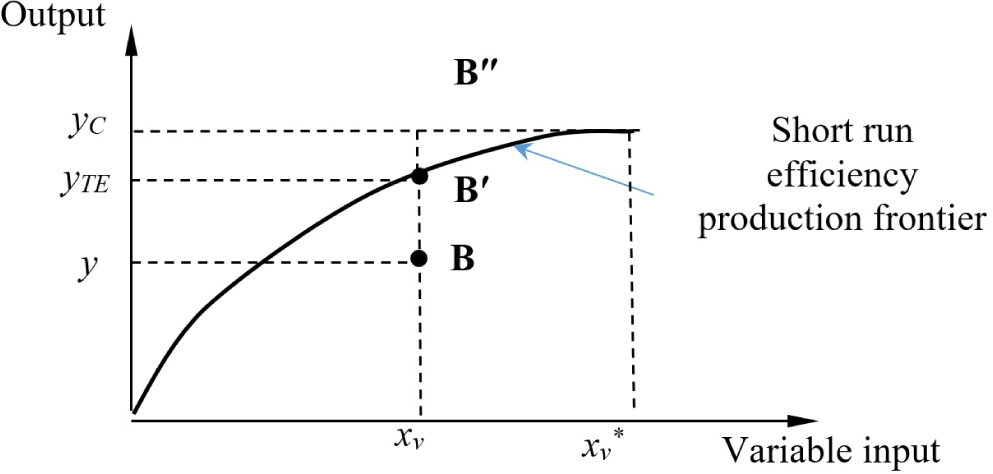
Assume that a fisher operates at point B using fixed inputs (vessel size) and variable inputs xv to harvest y quantity of fish. If all inputs are fully utilized (i.e., using xv* rather than xv variable inputs), and the vessel is operating at full technical efficiency (TE), then the potential (capacity) output would be yC. Increasing the quantity of the variable inputs beyond xv* does not increase output, as fixed inputs constrain production to yC.
Because an output-oriented TE (= y/yTE) is defined as the maximum quantity of outputs that a fisher could produce from a given set of inputs, an efficient vessel would be expected to produce yTE with an input level of xv. Hence, the difference yC−yTE is due to capacity underutilization; the difference yTE−y is due to technical inefficiency. Capacity underutilization due to underutilization of fixed inputs (or over-investment in capital stock) is CU* = yTE/yC = CU/TE; the variable input utilization rate is xv*/xv.
In this renewable resource industry, CU is a less useful concept at the fleet level than at the level of the individual vessel because of the focus on sustainable resource use. At the aggregate level, excess capacity is more informative (Dupont et al., 2002). The excess capacity of a fishing fleet is defined as the difference between the capacity output and the output that would be produced when resource levels equal the levels desired by resource managers (see, e.g., IISD, 2021). Capacity output is obtained for the fleet by aggregating each vessel’s capacity. In many oversubscribed fisheries, total fleet output is regulated by a total allowable catch (TAC) constraint. Excess capacity exists when a fleet has the capability to harvest more than a desired or target level of output, such as the TAC. If the current catch is chosen as the TAC, the excess capacity of a fishing fleet is the difference between its capacity output and the observed output. The excess capacity is thus the unused capacity of a fishing fleet; it is obtained by aggregating each vessel’s unused capacity. Similar to the unused capacity output of a fishing vessel presented above, the excess capacity output of a fishing fleet can also be decomposed into two sources: excess capacity due to technical inefficiency and excess capacity due to a shortage of variable inputs.
Data envelopment analysis (DEA), a nonparametric technique adopting a linear programing approach, is a leading analytical technique for analyzing production capacity and technical efficiency. This technique is favorable because it does not impose a priori functional form and allows for multiple output technologies (Badunenko & Mozharovskyi, 2016). The output-oriented radial model to estimate the ray capacity output level of the ith fishing vessel is presented as follows (see, e.g., Pascoe & Tingley, 2007). We denote the output vector of the ith fishing vessel (i = 1,…, 45) by and its fixed and variable input factors by and , respectively.
such that:
The vector of intensity variables z defines the reference technology given the observed inputs and outputs. These variables comprising z join the observed inputs and outputs to form the piecewise linear best-practice reference technology relative to which capacity is measured (i.e. the technology constructed by DEA). zi is the intensity variable for the ith fishing vessel; λin is the ratio of optimum input level to observed variable input use of is the proportion by which outputs of the ith fishing vessel may be expanded when production is at full capacity. The output constraint Equation (1) states that capacity output is less than or equal to the piecewise linear best-practice reference technology relative to which capacity is measured. The fixed input constraint Equation (2) implies that optimal usage of the fixed factor must be less than or equal to actual usage (Fare et al., 1989). The variable input constraint Equation (3) allows the variable inputs to be unconstrained (Fare et al., 1994). The constraints Equations (4) and (5) are non-negativity constraints. The Equation (6) is a convexity constraint which allows variable returns to scale.
The capacity output of the ith fishing vessel is then determined by multiplied by actual production . Hence, the ratio of observed over capacity output or CU is:
This measure provides a ray measure of capacity output and CU in which the multiple outputs are expanded in fixed proportions relative to their observed values (Segerson & Squires, 1990). The ray measure converts the multiple-output problem to a single-product problem by keeping all outputs in fixed proportions. The unused capacity output of the ith fishing vessel is
Next, the model for estimating the unused capacity output of the ith fishing vessel due to its technical inefficiency is presented (see Zhu, 2009). This is found by considering both the variable and the fixed inputs in the analysis (i.e. allowing variable inputs to potentially bind). It means that the variable input constraint becomes (i.e.= becomes ≥) in the following model.
such that:
The constraints for the technical efficiency model can be summarized as follows. The Equation (7) states that the efficient output is less than or equal to the piecewise linear best-practice reference technology relative to which technical efficiency is measured. The Equation (8) implies that optimal usage of the fixed factor must be less than or equal to actual usage. The Equation (9) shows that the optimal variable inputs must be less than or equal to actual usage. The constraint Equation (10) is non-negativity. The Equation (11) allows variable returns to scale. Next, the technically efficient output vector is calculated by multiplying by the observed production for each output . The unused capacity of the vessel due to its technical inefficiency is thus the difference between the technically efficient output and the actual output . The unused capacity of the vessel due to the underutilization of fixed inputs is . Hence, CU purging the effects of TE is:
As mentioned, fishers may concentrate their efforts on high-value or target species, so a precautionary approach should also investigate a partial CU (PCU) measure, which is defined as the observed output level divided by the capacity level of the output of concern given the actual output levels of all other products and fixed factors. The numerical value of the PCU measure will vary across products for each fishing vessel. Such measures might indicate that the degree of over-capitalization in the fishery can vary considerably across products (Segerson & Squires, 1990); there may be more excess capacity or higher rates of CU in the fishery of one species than in another. Here, the PCU measure is estimated for yellow fin tuna and big eye tuna, because these are the most important species in the SCS handline fishery. The PCU for a fishing vessel and Species 1 is as follows (see Zhu, 2009):
such that:
where Species 1 is the species for which the partial capacity measure is found. The constraints for the partial capacity model for Species 1 can be summarized as follows. The Equation (12) states that capacity output of Species 1 is less than or equal to the piecewise linear best-practice reference technology relative to which capacity is measured. The Equation (13) implies that output of other species keep unchanged. The Equation (14) shows that the optimal usage of the fixed factor must be less than or equal to actual usage. The Equation (15) is non-negativity. The Equation (16) allows variable returns to scale.
The partial capacity output of the ith fishing vessel for Species 1 is then determined by multiplied by the actual production . The partial unused capacity for Species 1 is . The PCU for the fishing vessel and Species 1 is as follows:
The survey of offshore handline vessels was administered to collect data for the fishing year-seasons 2015/2016. Following Long et al. (2008) and Duy et al. (2015), the questionnaire was adjusted to obtain data on the handline vessels in Khanh Hoa province. In this study, three districts in Khanh Hoa province –Vinh Tho, Vinh Phuoc and Xuong Huan– were purposely selected due to their high concentration of registered offshore handline vessel owners, and hence representativeness of the province. A sample of 45 handliners was randomly selected from the population of 303 registered offshore handline vessels obtained from the Fisheries Directorate of Khanh Hoa (Duc, 2021). The representativeness of this sample was also tested (Table 1). Vessel owners and/or their wives were interviewed face-to-face. Two main types of information were collected from the surveys: a description of the vessel’s technical and operational characteristics, and the costs and earnings data with and without the subsidies (Duc, 2021). Data were obtained from 15% (45 vessels) of the Khanh Hoa offshore handline vessels operating in 2016.
| Criteria | Sample | Mean population | t-test | p-value | ||
|---|---|---|---|---|---|---|
| N | Mean | SD | ||||
| Engine power (CV) | 45 | 401.78 | 110.60 | 410.00 | –0.499 | 0.621 |
| Hull length (m) | 45 | 15.97 | 1.13 | 15.90 | 0.392 | 0.697 |
Engine horsepower and hull length were the physical characteristics used to test the representativeness of the sample. A t-test was conducted to compare the engine power and hull length between the sample and overall population. The result from Table 1 demonstrates that the sample of 45 handliners is representative of Khanh Hoa’s offshore handline population.
There are three outputs for this handline fishery, which are measured in tons in the operating year of 2015/2016: yellow fine tuna (y1), big eye tuna (y2), and other fish (y3). The production function consists of three fixed and three variable inputs in Table 2. The fixed inputs are the length of the hull , engine power , and gross tonnage of the vessels. The variable inputs are the total quantity of fuel used by each fishing vessel per year , the average crew size , and the total fishing days per vessel in the operating year .
Results and Discussion
Summary statistics of input and output levels for Khanh Hoa’s handline vessels for the operating year of 2015/2016 are presented in Table 3. The mean quantity of yellow fin tuna harvested was 9.46 tons per vessel per year (min. 3.60 tons; max. 17.16 tons). The mean quantity of big eye tuna harvested by the sample vessels was 2.80 tons per vessel per year (min. 0.90 tons; max. 7.80 tons). The average quantity of other species harvested was 4.67 tons per vessel per year (min. 0.80 tons; max. 11.00 tons). Three fixed inputs were chosen as the proxies of capital investment: the mean hull length of the vessels was 15.97 meters (min. 13.80 meters; max. 18.95 meters). Engine power was measured as the physical quantity of horsepower (HP) for a fishing vessel, and sample vessels had, on average, 401.78 HP per vessel (min. 165.00 HP; max. 720 HP). The mean gross vessel tonnage was 33.13 (min. 3.60 tons; max. 17.16 tons). Three variable inputs were chosen, as mentioned above. The human labor input was measured as the average crew size, including the skipper, in the operating year; the mean crew size per vessel per year was 6.27 persons (min. 5.00 persons; max. 10.00 persons). The energy devoted to fishing was measured in liters of fuel per vessel for the operating year; the average was 43,555.56 liters of fuel per vessel per year (min. 24,000.00; max. 60,500.00). Finally, the average number of fishing days was 223.60 days per vessel per year (min. 140.00 days; max. 300.00 days).
The main drawback of the DEA approach is its sensitivity to noise (see Banker & Chang, 2006). Envelopment estimators can behave dramatically in the presence of noise, because they are very sensitive to extreme observations potentially caused by noise (Simar, 2007). To detect outliers, which can have a large influence on the estimated DEA frontier, the super efficiency test developed by Andersen & Petersen (1993) was used. The result of the CU estimates based on the super-efficiency procedure is: the mean of 1.37 with min. of 0.59 and max. of 2.40. This implies that the problem of outliers is not serious in this data set (see Bogetoft & Otto, 2010 for details).
CU was calculated as the ratio of observed catch to capacity output, including the effects of both technical inefficiency (fishing skill) and low levels of variable input usage. Table 4 shows that, on average, the CU for each fishing vessel is 0.815; the unused capacity is, thus, 18.5%. On other hand, the estimated capacity score of a fishing vessel is, on average, 1.302 (see Table 4). Because capacity scores are calculated as an output-oriented measure, these numbers suggest that vessels could increase their catch by about 30.2% on average if they were operating at full capacity.
| Criteria | Capacity score | Technical efficiency score | Capacity utilization | |
|---|---|---|---|---|
| CU | CU* | |||
| Mean | 1.302 | 1.155 | 0.815 | 0.910 |
| SD | 0.354 | 0.278 | 0.184 | 0.144 |
| Min | 1.000 | 1.000 | 0.422 | 0.422 |
| Max | 2.368 | 2.315 | 1.000 | 1.000 |
This unused capacity output of a fishing vessel comes from two sources: (i) the shortage of variable inputs and (ii) technical inefficiency (fishing skill). On average, the CU of a fishing vessel after purging the effect of technical inefficiency (CU*) is 0.910. This implies that the shortage of variable inputs used is thus the reason for 9% of unused capacity. Fishers could thus increase their catch without investing new capital or increasing vessel capacity if they used their variable inputs at optimal levels. Next, technical inefficiency leads to 9.5% (18.5% − 9%) of unused capacity. On the other hand, Table 4 also shows that the estimated technical efficiency score is 1.155, which indicates that fishers could increase the observed catch (see Table 2) by 15.5% at the present state of technology by using their disposable variable and fixed inputs more efficiently. Thus, both sources of the unused capacity output are significantly important in this fishery.
The variable input use for fuel, crew size, and fishing days is presented in Table 5. Variable input utilization rate, which measures the ratio of optimal to observed input use at technically efficient full capacity. The average fishing days utilization rate was 1.066 (SD of 0.175), which suggests that the observed fishing days for these fishing vessels were below their optimal levels or the number of fishing days at technically efficient full capacity (42% of fishing vessels operated fewer fishing days than the optimal). Vessels’ utilization rate of their crew size (0.983; SD of 0.087) lies very close to the optimal level (60% of fishing vessels operating at optimal crew size). On average, the fuel utilization rate is 0.922 (SD of 0.254), which indicates that vessels might benefit from a decrease in fuel use; 47% of fishing vessels use more fuel than would be optimal, and only 15% of fishing vessels used less fuel than the optimal level (see Table 5). The fuel subsidy program from Vietnam’s government may be the reason for this.
Vietnam’s Prime Minister (2010) and MARD (2011) introduced fuel cost subsidies based on the engine size of offshore fishing vessels. All Vietnamese vessels fishing offshore in the SCS could be supported up to a maximum of four trips per year. This support appears as quasi-lump sum subsidy per trip (for details, see Duy et al., 2015). Determining whether engine size might explain some of the variance in the CU of vessels operating offshore in the SCS is also important for policymakers. Of the 45 offshore handliners in this sample, the small vessel group includes 17 fishing vessels with an engine size smaller than 400 HP. Table 6 shows that this vessel group received lower fuel cost subsidies those received by the large fishing vessels with an engine size larger than or equal to 400 HP.
Table 6 also illustrates that the variable inputs used are lower but are very close to optimal for all fuel, crew size, and fishing days in the small vessels, with average variable input utilization rates of 1.019, 1.015, and 1.013, respectively. This means that the small vessels should, on average, increase their fuel use, crew size, and number of fishing days by 1.9%, 1.5%, and 1.3% compared to the current level if vessel operators desire to operate at full capacity output. The CU of 0.937 and the CU* of 0.962 are also very close to optimal for this vessel group. This means that the total unused capacity of small vessels is, on average, 6.3% (100 – 93.7%) of capacity output, and the unused capacity due to the shortages of variable inputs is only 3.8% (100 – 96.2%) of capacity output. These results suggest that fuel subsidies may help owners of small vessels overcome financial constraints that (i) limit the shortage of variable inputs and then improve CU*; and (ii) increase the rationale for choosing better variable input mix, thus increasing TE (see Long, 2022; Long et al., 2020). This is an important reason for the high levels of TE (0.975) and CU* (0.962) for this vessel group. The total unused fishing capacity of the small vessels is thus relatively small.
In contrast, the large vessels, which receive higher fuel subsidies, were only operating at 74.1% capacity, which is significantly lower than the small-vessel group (93.7%). This means that the total unused capacity for the large vessels is, on average, 25.9% (100 – 74.1%), and the unused capacity due to the shortages of variable inputs is 12.2% (100 – 87.8%) of the capacity output. Table 6 shows that the optimum fuel use falls below that observed for the large vessels, which suggests these vessels should use less fuel (13.6% of the current level) during the operating year. A closer investigation found that 68% of the large vessels overuse fuel. Optimum crew size also falls below the observed levels, which suggests that these vessels should use fewer crew members (3.7% of the current level) for the large vessels. On the other hand, the variable input utilization rate for fishing days is 1.097, which indicates that vessels should increase the number of fishing days compared to the optimal level by 9.7% if vessel operators desire to operate at full capacity output. This provides an important signal that fuel subsidies to large fishing vessels may lead to the overuse of fuel. There is also a significant shortage in the number of fishing days for this vessel group. Pham et al. (2014) also found overuse of fuel and a shortage of fishing days for large gillnet fishing vessels that received a fuel subsidy in Da Nang, Vietnam. These are important reasons for the lower TE (0.856) due to improper variable input mix and the lower CU* (0.878) due to a shortage of fishing days when compared to the small-vessel group. The total unused fishing capacity of the large vessel group is thus quite considerable.
To measure the excess capacity of the sample fishing fleet, the fleet measure of capacity output was first obtained by summing the capacity output over all vessels in this sample for each species. The excess capacity for each species was then calculated as the difference between the capacity output and the observed catch for the fleet. The fleet’s TE output levels were calculated for each species to provide an estimate of the excess capacity after purging the effect of TE. The fleet CU measure was obtained by the fleet observed output over the capacity output for each species. Similarly, the fleet CU* measure was obtained by the fleet observed output over the capacity output after purging effects of TE.
Table 7 illustrates that the sample fleet production of yellow fin tuna could have been 104.809 tons higher, at full capacity, compared to the observed catch, which corresponds to a total excess capacity for yellow fin tuna of 24.62%; excess capacity after purging the effects of TE was only 10.77%. The total excess capacity for big eye tuna is 28.28%, although after purging the effects of TE, it was 15.72%. This means that the excess capacity in this fishery is significant but moderate. If technical inefficiency is expected to remain constant—and hence latent—then the excess capacity of this fishing fleet is 10.77% and 15.72% for yellow fin tuna and big eye tuna, respectively. If technical inefficiency can be reduced—that is, if fishing skills improve through improved fishing practices, fishery development programs, or other means (which could be concomitant to, but not part of vessel decommissioning)—then this latent capacity due to technical inefficiency is meaningful and the excess capacity would be 24.62% and 28.28% for yellow fin tuna and big eye tuna, respectively.
On the other hand, fishers could concentrate their efforts on high-value or target species. The partial capacity measures that indicate how much the production of one output can be increased keeping the other outputs fixed has also been calculated to provide reference points for fisheries management. Partial capacity output of the fleet was first obtained by summing the partial capacity output over all vessels in this sample for each species. The partial excess capacity for each species was then calculated as the difference between the partial capacity output and the observed catch for the fleet. The fleet PCU measure was obtained by the fleet observed output over the partial capacity output for each species. The PCU of the sample fishing fleet was less than the CU for both species (see Table 7 and 8), which indicates that the partial capacity outputs for both yellow fin and big eye tuna were higher than their capacity outputs.
Table 8 also illustrates that the partial excess capacity for both species in this fishing fleet is quite considerable. Specifically, if the production of big eye tuna is fixed (along with the fixed factors and fixed resource stock), the total fleet production of yellow fin tuna could have been 203,641 kg higher compared to its observed catch. This corresponds to a partial excess capacity of this fishing fleet for yellow fin tuna of 47.83%. The partial excess capacity for big eye tuna would then be 80.62% compared to the observed catch. This result suggests that if fishers only target one species and the other outputs remain unchanged, the excess capacity of this fleet become significantly large, especially for big eye tuna.
Estimating fishing capacity is increasingly important because government should be responsible for sustainability of fisheries. The result of this study provides evidence that there may be a significant excess fishing capacity for the open-access offshore handline fishery in the SCS. If there is an excess fishing capacity in a fishery in the long-term, it might result in a gradual decline in the size of the stocks. In some cases, excessive effort levels associated with excess fishing capacity can cause reductions in fish stocks to levels where they are threatened with extinction. This is particularly the case if advances in fishing technology or increases in fish prices offset the effects of reduced stock size in the production process, so that it is still profitable to harvest species at very low stock levels. On the other hand, increased incidental catch of non-target species and habitat destruction directly also results from the excessive levels of fishing effort in fisheries characterized by an excess fishing capacity in a fishery in the long-term (see e.g., FAO, 2008).
Conclusion
This study analyzes the fishing capacity of the offshore multi-species fishing fleet in the context of the WTO agreement on subsidies for fisheries. Khanh Hoa’s offshore handline fleet in the SCS is used as an illustrative case. Based on the data of fishing year-seasons 2015/2016, the results show that Khanh Hoa’s handline fleet exhibits moderate symptoms of excess capacity. The average CU for Khanh Hoa’s handline fleet was estimated to be in the range of 0.80 and 0.91 for yellow fin tuna and 0.78 and 0.88 for big eye tuna. The excess capacity could thus increase from 10.77% and 15.72% to 24.62% and 28.28%, respectively, for yellow fin tuna and big eye tuna compared to current catches if TE were improved. Moreover, the small fishing vessels received lower fuel subsidization than the larger vessels in the operation year of 2015/2016. The small handliners are, however, very close to the optimal levels for all CU, TE and variable input utilization rates. The case is significantly different for large fishing vessels, which are, on average, only operating at 74.1% fishing capacity.
In the case of multi-species fisheries, however, fishers might concentrate their efforts on high-value or target species. The PCU measures indicate how much the production of one output can be increased keeping the other outputs (along with the fixed factors and resource stock) fixed. The results suggest that if fishers only target one species and the other outputs remain unchanged, the partial excess capacity of the fleet would be significantly large—reaching 80.62% for big eye tuna. This may be an important reference point for sustainable fisheries management.
Indeed, fuel cost subsidies might have created an economically inefficient industry and increased the probability that fish stocks will be exploited beyond their biological limits, although such subsidies maintain employment and prevent the collapse of fishing communities in developing countries like Vietnam. This study provides evidence that fuel subsidies may help owners of small vessels overcome financial constraints, where the unused fishing capacity is minor. The case is, however, significantly different for large fishing vessels. The study found that 68% of the large vessels overuse fuel, and their unused fishing capacity is significantly large. If fuel support for the large vessels is maintained instead of being gradually phased out, improper incentives that lead to the long-term depletion of the offshore fish stock and result in economic waste must be avoided. Another consequence of direct fishing subsidies for large fishing vessels may be the fueling of an international fishing war among countries involved in the shared stock fishery, especially in disputed sea areas like SCS (see, e.g., Long, 2009b). Given the negative side effects of fuel subsidies to fisheries, the government should thus selectively subsidize small handliners. Moreover, fuel support for the large-scale handliners should be gradually phased out. Indirect supports such as training the fishing crew, providing information about the fish stock, and forecasting the weather on the high seas which improve the TE, will be more appropriate for large-scale handliners in the SCS.
Finally, this study has some limitations. The first is that our analysis and results were applied to only a single year of fishing operations (2015/2016) for the Khanh Hoa’s offshore handline fishery. The measures of fishing capacity were thus conditional on the resource conditions for this fishing year. Changes in these conditions might alter the results, which our analysis does not depict. Moreover, the study lacks an in-depth analysis of how policy changes might affect fishing communities and local economies. Hence, detailed, actionable recommendations for a phased fuel subsidy reduction plan, alternative support measures, or strategies to safeguard fishing communities could not be proposed. To help policymakers design detailed policy changes, future work should: (i) include more extensive data collection across different regions and time frames; (ii) critically analyze how fuel subsidy policy changes might affect fishing communities and local economies.