Introduction
Co-management refers to a governance structure in which authority and responsibility for resource management are jointly exercised by governmental agencies and local resource users (Carlsson & Berkes, 2005). Fisheries co-management has gained increasing attention as a governance approach capable of addressing the complex challenges of managing fisheries resources. By fostering collaboration between state institutions and resource users, co-management enables more adaptive and inclusive management practices. It emphasizes joint decision-making, shared responsibility, and the incorporation of local knowledge—elements that are particularly important in managing social-ecological systems where centralized regulation alone is insufficient (Berkes, 2009; Folke et al., 2005).
The growing interest in co-management reflects a broader search for effective governance mechanisms that integrate state-led regulation with local user capacities (Pomeroy & Berkes, 1997). Although co-management has been applied across multiple sectors, fisheries offer a particularly relevant case, as management structures often rely on voluntary partnerships between local communities and government actors, reflecting bottom-up organizational forms (Jentoft et al., 1998). Centralized, command-and-control approaches have shown limitations in fisheries contexts (Pinkerton, 1989; Trimble & Berkes, 2015), prompting attention to cross-scale institutional linkages—both vertical and horizontal—that align with the logic of nested institutional arrangements in natural resource governance (Plummer et al., 2012).
Within this broader context, South Korea presents a compelling case for understanding how co-management functions in practice. The fisheries co-management policy, initiated by the Ministry of Oceans and Fisheries, has been implemented to promote the sustainable use of marine resources since 2001. This policy encourages local fisheries communities to establish autonomous regulations and engage in collective action to preserve shared resources. While the institutional structure of co-management in Korea has matured over the past decade, considerable variation remains in how actively local communities participate in co-management. Understanding the factors that drive this variation is essential for improving the effectiveness of the fisheries co-management policy.
Existing research has identified a number of factors that influence co-management performance, including leadership, organizational capacity, local resource conditions, and socioeconomic characteristics (e.g., Pomeroy & Berkes, 1997). However, much less attention has been given to the governance-related perceptions held by community members themselves. As co-management aims to promote collaborative governance, it is also important to consider how perceptions of inclusion in decision-making, power-sharing, and trust in government agencies affect community engagement.
Fisheries Community–Government Relations in Co-Management
In the context of fisheries co-management, the relationship between fisheries communities and public agencies is critical in shaping policy outcomes. A wide range of factors has been shown to influence the effectiveness of co-management as a form of collective action. These include group size, heterogeneity, communication capacity, access to information, social norms, and perceptions of cooperation (Baland & Platteau, 1996; Fischbacher et al., 2001; Frey & Meier, 2004). Building on this literature, the present study focuses on three key governance-related perceptions: perceived inclusion in decision-making, perceived power-sharing, and trust in government institutions. These perceptions are recognized as foundational components of well-functioning co-management systems.
Co-management is inherently multi-level and multi-actor in nature, involving interactions among local communities, government agencies, and other stakeholders (Armitage et al., 2007). It emphasizes the integration of diverse forms of knowledge, joint decision-making, and the equitable distribution of authority. Within this framework, the extent to which communities feel included in fisheries-related decision-making processes plays a critical role in enhancing the legitimacy of co-management and motivating communities to actively participate. Likewise, power-sharing between local communities and government agencies is important in ensuring that co-management is not merely symbolic but substantively participatory, thereby contributing to more sustainable governance outcomes.
Trust, in this context, refers to an individual’s subjective expectation that another actor or institution will behave in a cooperative and predictable manner (Ostrom & Ahn, 2009). Trust reduces transaction costs, particularly those related to contracting and monitoring, and facilitates smoother collaboration between actors (Dyer & Chu, 2003; Uzzi, 1997). Previous empirical studies have demonstrated that higher levels of perceived trust are associated with reduced enforcement burdens and increased willingness to cooperate in fisheries governance, as evidenced in survey-based research conducted in Brazil (Cavalcanti et al., 2010). Building on these insights, this study examines how fishers’ perceptions of inclusion in decision-making, power-sharing, and trust in government agencies influence their engagement in co-management activities in South Korea.
This study investigates whether and how these relational factors shape participation in co-management practices. Using survey data from leaders and managers in fisheries communities, it examines the extent to which perceived inclusion, power-sharing, and trust influence involvement in co-management activities. By focusing on these governance dynamics, the study contributes to a deeper understanding of institutional relationships and community empowerment in designing and implementing sustainable resource governance.
Materials and Methods
The Korean Peninsula is situated in the northwestern Pacific region, with South Korea occupying the southern portion and surrounded on three sides by the ocean (Song, 2015). Given the regionally diverse characteristics of its coastal areas, the South Korean government has faced limitations in enforcing uniform, top-down regulatory frameworks. These challenges have prompted the need for more localized, participatory forms of governance in fisheries management. In response, the Korean government introduced the Fisheries Co-Management Policy (known as the Jayul policy) in 2001. This initiative marked a shift toward co-management by encouraging voluntary associations of fishers to self-organize and assume greater responsibility for managing their marine resources. The policy facilitates collaboration among central government agencies, local governments, non-governmental organizations, and fisheries communities.
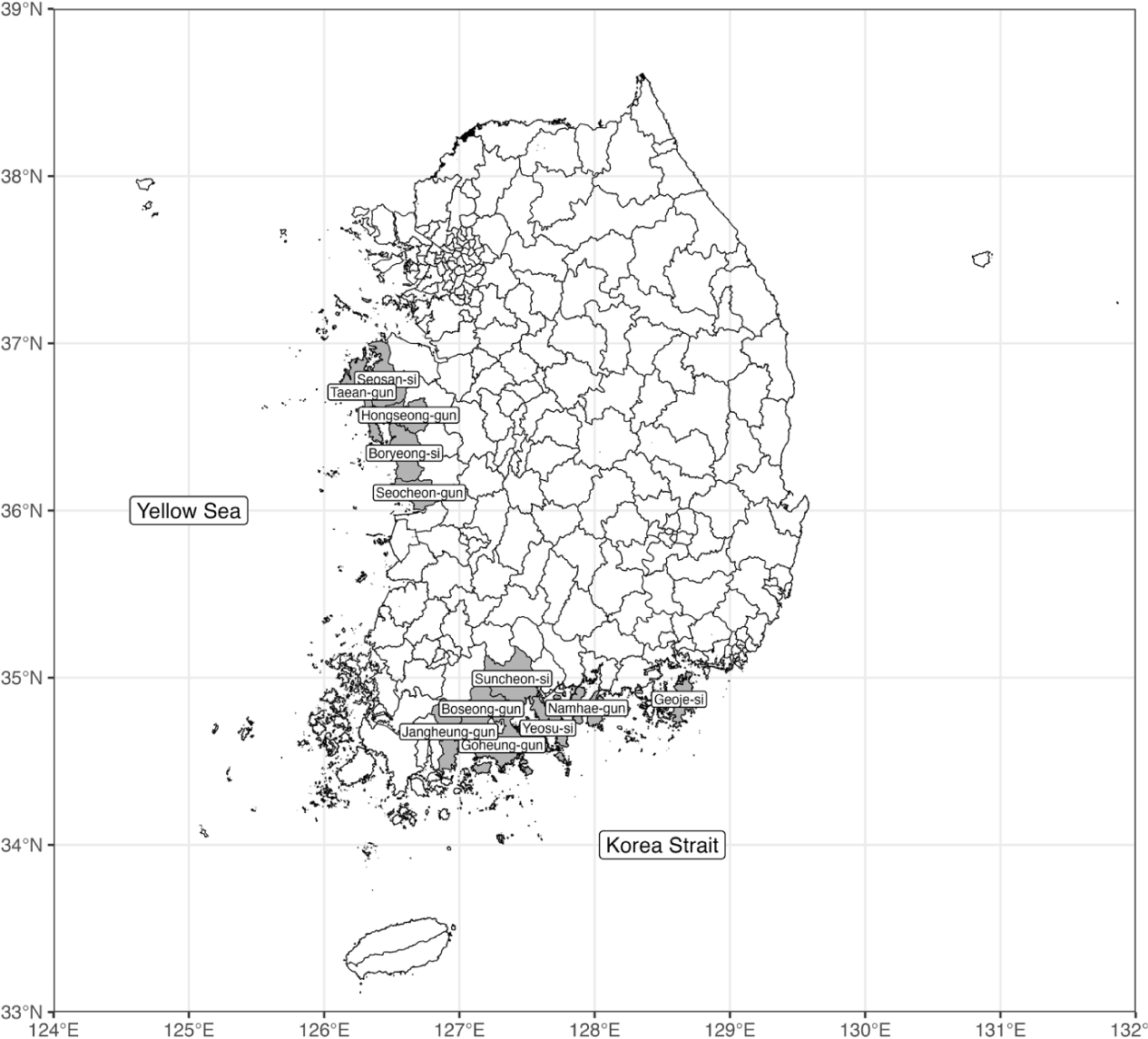
This study draws on survey data collected from leaders or administrative managers representing fisheries communities participating in Korea’s co-management policy. The target communities are located in two coastal regions of the Korean Peninsula: the mid-southern coast (Korea Strait) and the mid-western coast (Yellow Sea). These regions were chosen for several reasons. First, although all three seas surrounding the Korean Peninsula provide productive fishing grounds, the mid-western and mid-southern coasts are particularly important areas for fisheries due to their diverse resources. Second, these two areas offer an appropriate setting for examining both similarities and differences in co-management practices. While they share comparable fish species and fishing grounds, they also display distinct ecological characteristics. The Yellow Sea, with its broad tidal flats and significant tidal ranges, supports species such as oysters, sea cucumbers, Manila clams, abalone, and various shellfish and seaweeds. By contrast, the Korea Strait, characterized by winding coastlines and numerous islands with sandy beaches, rocky shores, and tidal flats, is home to cod, anchovy, Korean rockfish, Sebastes schlegelii, oysters, sea cucumbers, and Manila clams. Finally, the researcher possesses substantial first-hand knowledge of these regions, along with established relationships with fisheries communities located there, which facilitated data collection. The geographical distribution of survey sites is illustrated in Fig. 1.
The analysis focuses on village fisheries communities (maeul-eo-eop communities), which are universally organized around Uchon-gye (fishing cooperatives) in South Korea. As the institutional basis for co-management, each Uchon-gye manages village-owned fishing grounds under a community-based framework, with leaders and managers representing the collective interests of fishers (Cheong, 2004; Song, 2015). By analyzing communities practicing village fisheries through Uchon-gye, this study emphasizes their shared institutional basis.
Data were collected via telephone and mail surveys conducted between December 2020 and February 2021. Specifically, surveys were administered in fisheries office districts within the Korea Strait region (Taean-gun, Boryeong-si, Namhae-gun, and Geoje-si) and the Yellow Sea region (Yeosu-si, Goheung-gun, and Jangheung-gun). The unit of analysis in this study is the community, reflecting the central role that collective organization plays in the implementation of co-management. Leaders and administrative managers of each fisheries community were selected as respondents, as they are directly involved in coordinating co-management activities and possess detailed knowledge of their community’s governance and practices through their managerial roles. A total of 73 community-level observations were included in the analysis.
Data analysis
The dependent variable in this study is the level of co-management activities undertaken by fisheries communities. It is measured using a survey questionnaire comprising nine binary sub-items. Respondents indicated whether their communities had changed how they conduct specific co-management activities following participation in the co-management policy. The overarching objective of the policy is to promote more active engagement in co-management practices after participation.
This study focuses on co-management activities applicable across all types of fisheries, excluding those specific to a particular sector, such as coastal fisheries alone. The selected activities include: (1) assigning and rotating fishing grounds, (2) monitoring illegal fishing, (3) cleaning fishing grounds, (4) restocking, (5) removing harmful species, (6) enforcing total catch limits, (7) policing catch size and age limits, (8) implementing seasonal closures, and (9) safeguarding protected areas.
To evaluate policy impact, the study measures the change in each community’s engagement in these activities before and after policy participation. A score of 1 is assigned if the community either (a) initiated the activity after policy implementation, or (b) increased the level of engagement in an activity already in place. A score of 0.5 is assigned if the activity level remained the same before and after participation, and a score of 0 if the activity was not performed in either period. The scores from the nine items were summed to create a composite index of co-management activity. The internal consistency of this scale, as assessed by Cronbach’s alpha, was 0.72, indicating acceptable reliability for research purposes.
The independent variables capture community members’ perceptions of governance in the context of fisheries co-management, with a particular focus on the relationship between government agencies and fisheries communities. Three key dimensions were included in the analysis: perceived inclusion in decision-making, perceived power-sharing, and trust in government agencies.
Perceived inclusion in decision-making was measured by asking respondents the extent to which they believe the opinions of fisheries communities are reflected in government decision-making concerning both co-management and broader fisheries policies. Responses were recorded on a five-point Likert scale, ranging from “not at all” (1) to “very much” (5). Perceived power-sharing was assessed through a separate item that asked how much influence the fisheries community should have in government decision-making related to co-management. This item used a binary scale, coded as 1 for “already has sufficient influence” or “appropriate,” and 2 for “should have much more influence.”
In the context of co-management, trust between local communities and government agencies plays a critical role in achieving successful and sustainable management outcomes. Trust in government institutions was measured by asking respondents how much they trust the agencies responsible for fisheries management. This item was recorded on a five-point Likert scale ranging from “do not trust at all” (1) to “trust completely” (5).
Socio-demographic variables were also included in the analysis. These consisted of the population size of each fisheries community and the median age of its members. For analytical purposes, population size was log-transformed, and age was categorized on a five-point scale ranging from 1 (30–39 years) to 5 (70–79 years). In addition, a regional dummy variable was included to distinguish between communities located in the southern region (coded as 1) and those in the western region (coded as 0). These variables were incorporated into a multiple linear regression model to examine how perceived inclusion in decision-making, perceived power-sharing, and trust in government agencies are associated with co-management engagement among fisheries communities.
Results
Table 1 presents the descriptive statistics for the variables included in the analysis. Community population is reported as the raw count and has not been log-transformed in the table. Regarding regional location, a value of 1 indicates communities located in the southern region, while 0 denotes communities in the western region.
Table 2 reports ordinary least-squares estimates from a linear model of the co-management activity index, a composite measure derived from nine co-management practices. Model 1 includes only governance perception variables, and Model 2 adds community-level control variables. This study focuses on interpreting Model 2. Among the key governance perception variables, perceived power-sharing in fisheries management was significantly and positively associated with co-management activity levels (β = 1.194, p < 0.01). This indicates that communities that believe they should have greater power in the government policy process tend to engage more actively in co-management.
Similarly, trust in government agencies was positively associated with co-management performance (β = 0.580, p < 0.01), suggesting that higher levels of institutional trust are linked to greater community participation in policy-driven management activities. In contrast, perceived inclusion in decision-making, which refers to the extent to which respondents believe that community opinions are reflected in actual government decisions, showed a positive but statistically insignificant association with co-management activity. This result may indicate that perceived power-sharing and trust exert a more direct influence on behavioral engagement than perceptions of procedural inclusion alone.
Among the control variables, community population was a significant predictor (β = 1.052, p < 0.01), indicating that larger communities are more likely to participate in a broader range of co-management practices. Other variables, including community median age and regional location, were not significantly associated with the dependent variable.
Discussion and Conclusion
Local communities and the institutional support they receive are critical for effective resource management (Cudney-Bueno & Basurto, 2009). While material support for local communities, such as financial incentives provided through co-management systems, is an important component of sustainable fisheries (Gutiérrez et al., 2011; Kooiman, 2003), relational dimensions of governance between government agencies and local fisheries communities also play a significant role in shaping co-management performance. This study examines how communities’ perceptions of fisheries co-management governance—specifically perceived inclusion in decision-making, perceived power-sharing, and trust in government agencies—are associated with the level of co-management activity among fisheries communities in South Korea.
The findings indicate that perceived power-sharing is a significant predictor of community engagement. Communities that believe they should hold greater authority in government decision-making tend to be more actively involved in implementing co-management practices. This highlights the importance of perceived legitimacy and meaningful participation in policy processes. To enhance co-management outcomes, government agencies should continue their efforts to promote perceived power-sharing among fisheries communities by recognizing them not only as stakeholders but also as active decision-makers in policy formulation and implementation.
Similarly, trust in government agencies was positively and significantly associated with co-management performance. This finding aligns with previous research emphasizing the importance of trust between government fisheries officers and resource users in achieving successful co-management outcomes (Kim, 2023; Nunan et al., 2015). Trust plays a critical role in facilitating cooperation between local communities and public institutions by reducing uncertainty and encouraging compliance with shared objectives. This result supports theoretical perspectives suggesting that co-management outcomes are more likely to improve when mutual trust exists between actors operating at different levels of governance (Nunan et al., 2015). Moreover, transparent communication is essential for building such trust and is widely recognized as a key factor in effective resource management (Röckmann et al., 2017). While trust among community members fosters internal cohesion and collaboration (Kim, 2025), trust in government institutions is equally vital for motivating communities to actively engage in co-management practices. Furthermore, as Kim (2025) notes, some communities face challenges in implementing co-management due to limited resources and constrained accessibility. Government agencies should therefore consider providing targeted capacity-building support, particularly for smaller or resource-limited communities, to strengthen their capacity for meaningful participation in co-management.
This study has some limitations. First, the analysis relies on cross-sectional data collected from a limited number of regions, which may restrict the generalizability of the findings. Future research could expand the geographic scope, including communities in the eastern coastal areas, to gain a more comprehensive understanding. In particular, given that the northern and southern parts of the East Sea differ considerably in ecological and fishery conditions, future studies should carefully account for this regional heterogeneity. Second, considerable heterogeneity also exists within the current regional categories in terms of fishers’ characteristics, fishing practices, and administrative contexts. Because village fisheries communities encompass diverse fishery types, differences across fishery types may influence governance practices and perceptions, including trust in government. Future studies should explicitly incorporate fishery type as an analytical factor. Third, while this study focuses on community-level perceptions, the data were obtained from individual leaders or administrative managers. Incorporating the perspectives of a broader range of community members through interviews or participatory research methods would further strengthen future research. Fourth, although the nine binary items were combined into a single index variable, the binary response format and relatively small sample size (n = 73) may still limit variance and measurement precision. More broadly, the scope and precision of the findings are inevitably constrained by the available data and survey design. Future research should employ larger samples, more structured survey instruments, and potentially mixed methods (e.g., interviews or participatory approaches) to provide deeper and more comprehensive evidence.
Despite these limitations, the study contributes to our understanding of how governance perceptions, particularly those related to inclusion, power-sharing, and trust, influence community engagement and performance in fisheries co-management. By highlighting the importance of these relational dimensions, the research offers practical insights for policymakers seeking to promote sustainable resource management through authentic and inclusive collaboration between government institutions and local communities.