Introduction
In Côte d’Ivoire, national aquaculture production is dominated by Oreochromis niloticus. This species accounts for more than 90% of total output (Anvo et al., 2025). It shows outstanding zootechnical performance and displays strong resilience and high environmental tolerance (Wagaw et al., 2024). For these reasons, O. niloticus has been the focus of extensive research and has also been central to large-scale development programs worldwide.
Despite these advantages, the high reproductive capacity of O. niloticus remains a major constraint for aquaculture. O. niloticus reproduces spontaneously and reaches sexual maturity early. Its reproductive cycle is continuous. These characteristics lead to uncontrolled fry proliferation. They also cause reduced growth under confined aquaculture conditions (Singh, 2013). Furthermore, males exhibit faster growth than females in O. niloticus, mainly due to genetic, hormonal, and behavioral factors (Angienda et al., 2010; Toguyeni, 1996). Consequently, the production of all-male populations has been widely adopted as the most economically viable strategy in O. niloticus farming (Singh, 2013). Several approaches have been developed to achieve this goal. These include hormonal sex reversal, thermal treatment, and YY-male breeding programs. However, each method presents specific limitations. Hormonal treatments raise environmental and food safety concerns. Thermal sex reversal yields inconsistent results across strains. YY-male breeding programs are technically demanding and time-consuming (Basavaraju, 2023). Collectively, these constraints limit the large-scale adoption of monosex production, particularly in small- and medium-scale aquaculture producers in developing countries.
In response to these constraints, alternative strategies have been investigated to optimize productivity with mixed-sex tilapia populations (Bostock et al., 2022). In mouthbrooding cichlids such as O. niloticus, successful spawning depends on substrate availability for nest construction and egg deposition before oral incubation by the female (Shoko et al., 2015). Therefore, farming systems that prevent nest construction or egg deposition may suppress reproduction and potentially reduce fry proliferation.
Floating net-cage culture involves farming fish in cages suspended within natural or artificial water bodies (Cardia & Lovatelli, 2015). This system ensures continuous water exchange and controlled feeding. It also supports high production performance in riverine environments (Jamaluddin et al., 2025). Importantly, the absence of suitable spawning substrates in cages may limit reproductive activity in O. niloticus, offering a practical alternative to costly reproductive control methods in mixed populations (Beveridge, 2004).
Within this context, the effects of cage culture conditions on the zootechnical performance of O. niloticus remain insufficiently documented. In particular, the influence of population sex composition on growth performance and production efficiency requires further investigation. Therefore, the present study addressed two main objectives. First, it evaluated the growth performance and economic profitability of all-male, all-female, and mixed-sex populations of O. niloticus. Second, it determined the most suitable sex composition for commercial cage farming. To achieve this, O. niloticus from the Brazilian strain were reared in floating net cages installed in the N’Zi River in Côte d’Ivoire. The findings of this study aim to provide evidence-based recommendations to optimize monosex and mixed-sex production strategies under tropical riverine cage-culture conditions.
Materials and Methods
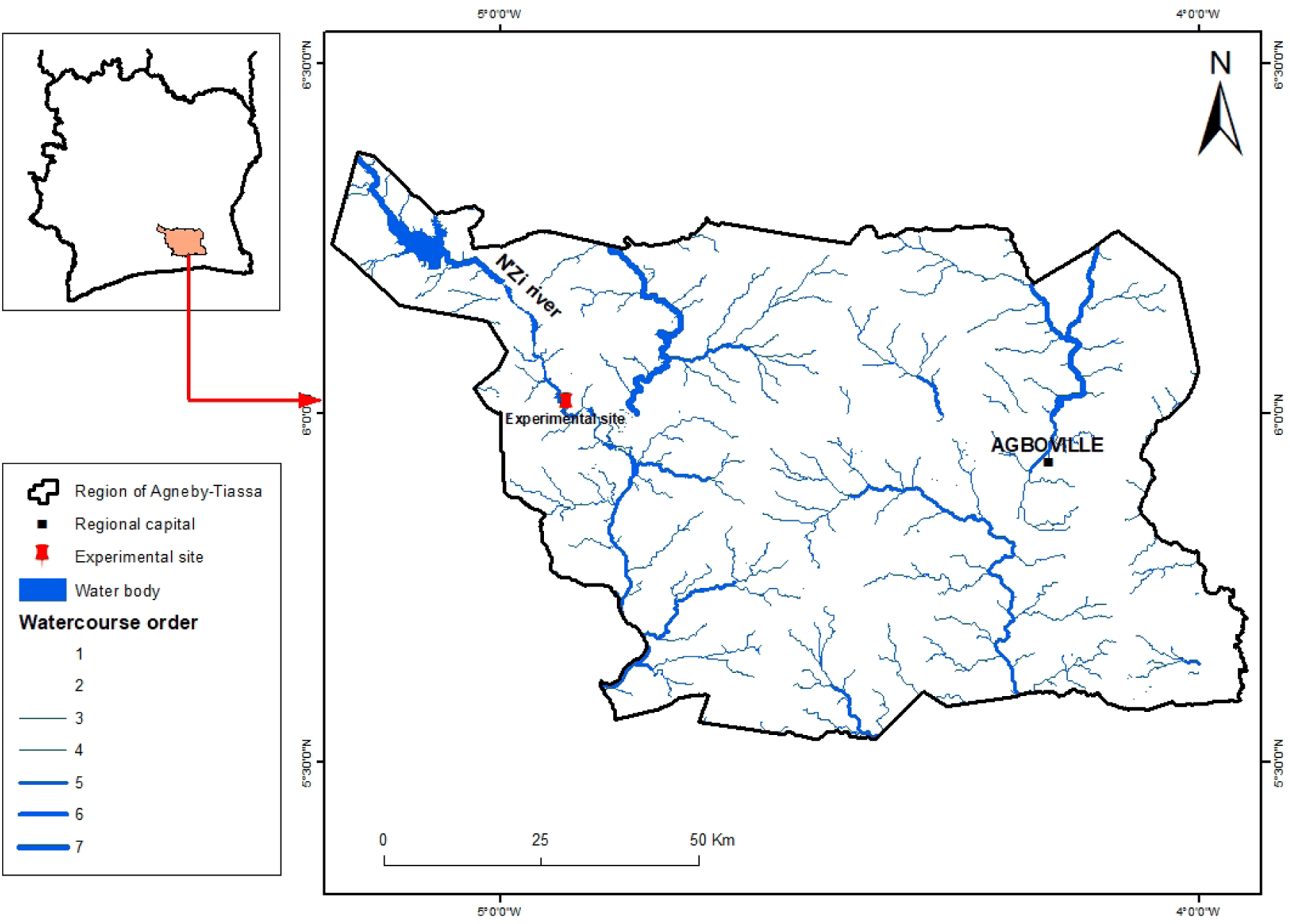
The study was conducted in six (6) floating cages with a usable volume of 100 m3 each (5 × 5 × 4 m), set up in the N’Zi River (6°00'39'' N, 4°54'19'' W) in Côte d’Ivoire (Fig. 1). The cages were spaced approximately 3 meters apart and were arranged along a line perpendicularf to the direction of river flow. This configuration was specifically designed to minimize hydrological connectivity among cages and reduce the potential transfer of waterborne chemical cues between treatments.
A total of 28,800 juveniles of O. niloticus (Brazilian strain), with an average weight of 19.95 ± 2.41 g, produced at the Inland Fisheries and Aquaculture Research Station of Bouaké (Côte d’Ivoire), were distributed among the experimental cages. The experimental setup included 9,600 all-male juveniles obtained through α-methyltestosterone sex reversal, 9,600 all-female juveniles, and 9,600 juveniles from mixed-sex batches.
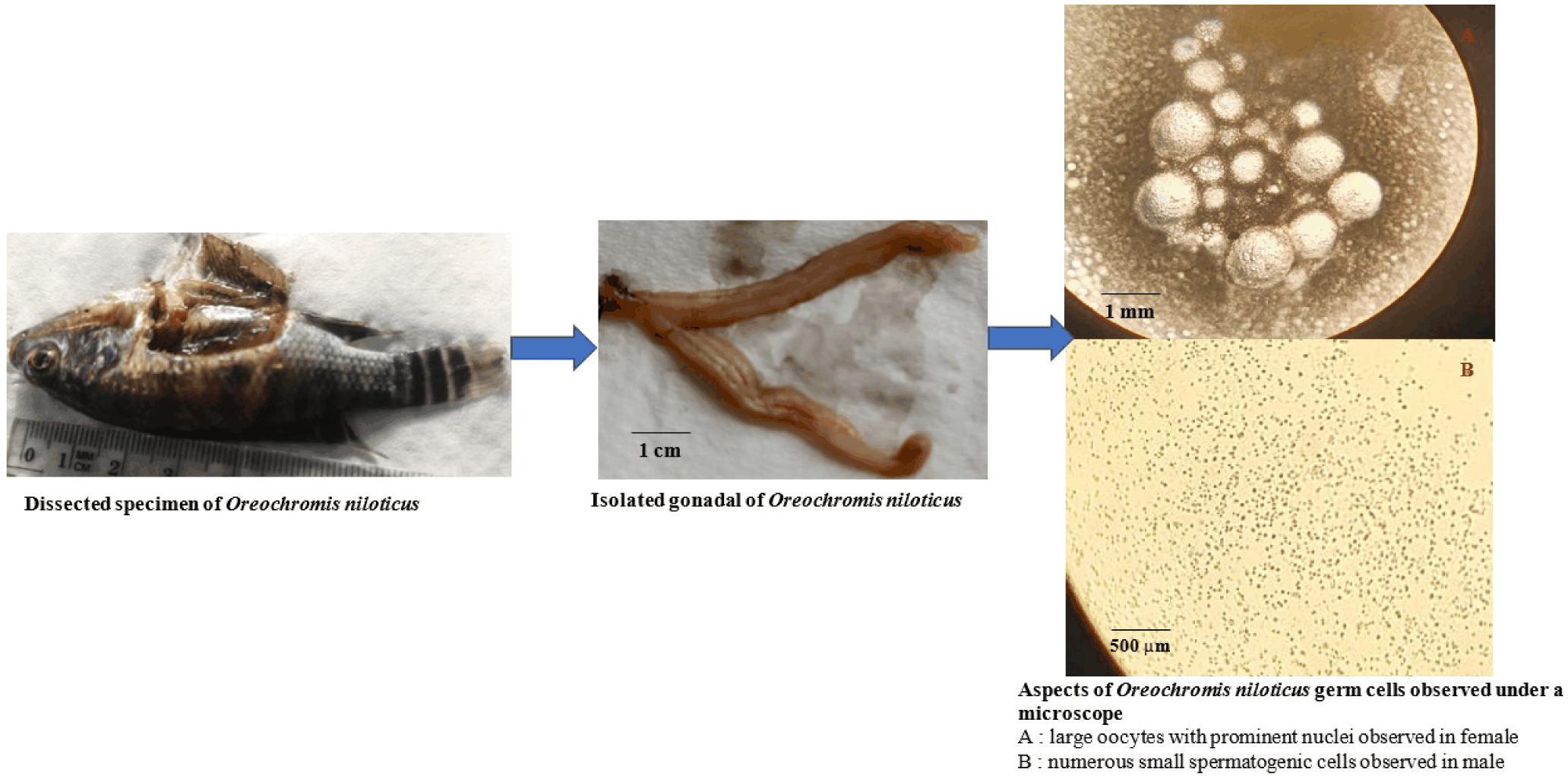
The effectiveness of the sex reversal treatment was verified in a representative subsample (n = 240 individuals) through gonadal squash preparation, followed by systematic macroscopic morphological examination of all specimens used in the experiment. The sex ratio in the mixed-sex groups (1:1) was determined using the gonadal squash method on a representative subsample (240 individuals). Female batches were obtained through morphological examination. Fish were first euthanized in accordance with established ethical guidelines for vertebrate research. Gonadal tissues were then aseptically removed by surgical dissection. A small gonadal fragment was excised and placed on a clean glass slide. One drop of isotonic saline solution (0.9% NaCl) was added. The fragment was gently compressed under a coverslip to disperse the cells. The resulting preparation was examined under a light microscope to identify germ cells. Sex was determined based on cellular composition, following the criteria described by Lowerre-Barbieri et al. (2011). Males were identified by the presence of numerous small spermatogenic cells and mature spermatozoa. Females were characterized by large oocytes with prominent nuclei (Fig. 2).
Each cage received 4,800 juveniles, resulting in a stocking density of 48 fish m−3, with two repetitions per treatment. This density represents a balance between practical constraints related to fingerling availability and scientifically validated cage-culture densities of approximately 50 fish m−3 previously recommended for Nile tilapia by Yi et al. (1996). Accordingly, cages 1 and 4 were stocked with all-male monosex population, cages 2 and 5 with all-female monosex fish, and cages 3 and 6 with mixed-sex batches. An extruded commercial feed was used for fish feeding. The daily ration was divided into two meals and manually distributed to the fish. Growth monitoring was performed monthly to assess fish performance and adjust feeding rates accordingly. For this purpose, a random sample of 480 fish was collected from each cage using a hand net fitted with a 2-m handle. Fish were counted and batch-weighed using a digital scale with a 50-kg capacity and 5-g precision. Female reproductive activity was assessed by identifying and counting mouthbrooding females exclusively through direct capture and buccal inspection during monthly sampling and final harvest in each treatment. The rearing trial lasted four months (from December 2023 to March 2024).
The quality of the rearing environment was monitored through the measurement of physico-chemical parameters of the water in the floating cages. The parameters were recorded on a monthly basis, with two measurements taken on the same day (09:00 and 17:00) in the six cages. Accordingly, Water temperature, pH, conductivity, dissolved oxygen, transparency, and depth were measured monthly. The first four parameters were measured in situ using a HANNA HI 9828 multi-parameter. Water transparency was determined with a Secchi disk, and depth was measured with portable handheld depth sounder (Plastimo Echotest II).
To evaluate fish zootechnical performance and the profitability of the farming systems the following indices were calculated:
Mean weight gain (MWG, g) = final weight (g) – initial weight (g);
Daily weight gain (DWG, g/day) = (final weight (g) – initial weight (g)) / rearing period;
Specific growth rate (SGR, %/d) = 100 × [Ln (final weight) – Ln (initial weight)] / rearing period;
Survival rate (SR, %) = 100 × (final number of fish / initial number of fish);
Coefficient of variation of mean weight (CV) = 100 × [standard deviation of final weight / mean weight];
Feed conversion ratio (FCR) = quantity of dry feed distributed (g) / fresh weight gain (g);
Total expenditure (USD) = total cost of feed (USD) + labor cost (USD) + cost of fry (USD) + cost of other charges (USD), The unit costs of fingerlings were estimated at 0.1769 USD for males and 0.0884 USD for females and mixed-sex groups; repair and maintenance costs of the cages are included under other charges;
Production cost (USD/kg) = total expenditure (USD) / biomass produced (kg);
Revenue (USD) = 4.42 USD × biomass produced (kg), 4.42 USD was the cost of 1 kg of fish;
Net profit (USD) = revenue (USD) – total expenditure (USD).
Physicochemical, zootechnical, and profitability parameters recorded during the trial were first tested for normality using the Shapiro–Wilk test and subsequently analyzed using one-way analysis of variance (ANOVA). When significant effects were detected (p < 0.05), Tukey’s post hoc test was applied to assess pairwise differences among treatments for each parameter.
Results
The physicochemical parameters of the water recorded in the cages varied over the study period (December 2023–March 2024), as shown in Table 1. The pH varied from 7.01 to 7.25, with an average of 7.12 ± 0.08. The highest value was recorded in March and the lowest in February. Dissolved oxygen averaged 5.41 ± 0.12 mg L−1, fluctuating between a minimum of 5.20 mg L−1 in February and a maximum of 5.57 mg L−1 in January. Conductivity displayed the widest range of variation, spanning from 21.39 μS cm−1 in December to 65.34 μS cm−1 in February, with an overall mean of 51.13 ± 14.85 μS cm−1. Water transparency ranged from 61.73 (March) to 74.60 cm (December), with an average of 68.08 ± 3.62 cm. Water depth averaged 17.13 ± 0.67 m, with the highest value recorded in December (18.15 ± 0.21 m) and the lowest in March (15.78 ± 0.09 m).
Zootechnical parameters are presented in Table 2. Although no significant differences in initial mean weight were detected among treatments (p > 0.05), the all-female monosex groups displayed a numerically higher mean value (22.08 ± 1.1 g) than the all-male monosex (17.43 ± 1.21 g) and mixed-sex groups (17.36 ± 1.39 g).
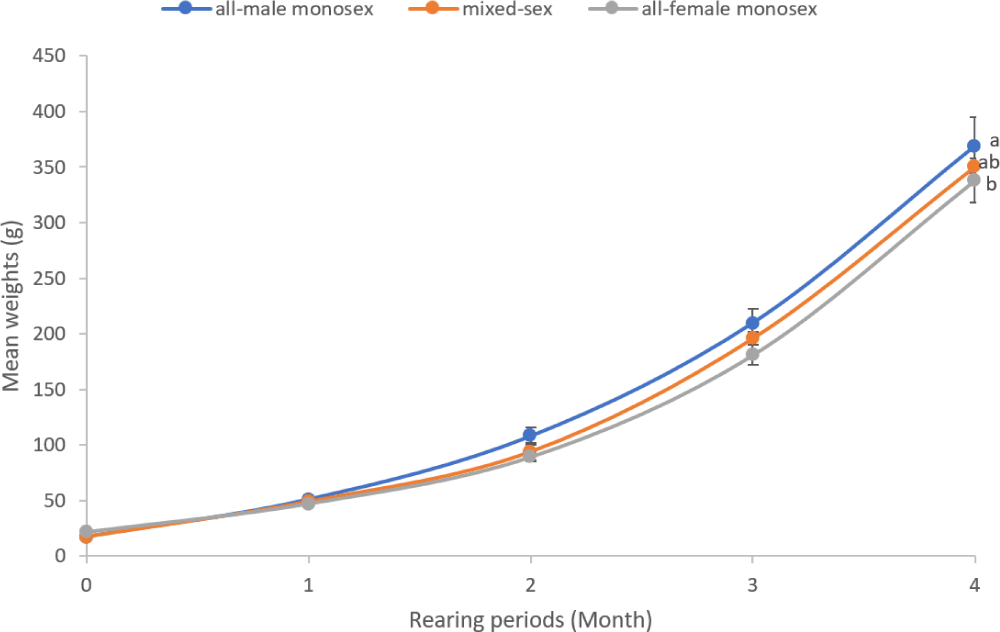
At the end of the four-month rearing period, the Brazilian strain of O. niloticus reared in cages achieved an overall mean survival rate of 81.49% ± 0.61%, with a range of 80.58%–82.29%. The highest survival was recorded in the mixed-sex group. The lowest was observed in the all-male monosex population. Final mean weight (FMW) differed significantly among treatments (p < 0.05). All-male monosex group achieved the highest FMW (369.45 ± 12.25 g), followed by mixed-sex group (350.76 ± 11.51 g) and all-female monosex group (338.14 ± 9.76 g). Weight growth curves (Fig. 3) overlapped across all culture systems during the first 60 days of rearing. From day 60 onward, growth accelerated markedly in all-male group. Mixed-sex group then outperformed all-female monosex group for the remainder of the rearing period. MWG also differed significantly among treatments (p < 0.05). The highest MWG was recorded in all-male monosex group (352.02 ± 11.43 g). The lowest was observed in all-female monosex group (316.06 ± 8.19 g). Average DWG followed the same trend. It ranged from 2.86 ± 0.08 g day−1 in all-male monosex group to 2.56 ± 0.09 g day−1 in all-female monosex group. SGR differed significantly among treatments (p < 0.05). All-male monosex group exhibited the highest SGR (2.48% day−1 ± 0.03% day−1). All-female monosex group recorded the lowest value (2.21% day−1 ± 0.06% day−1). The CV of mean body weight ranged from 2.88% in all-female monosex population to 3.48% in all-male monosex group.
Feed distributed per fish did not differ significantly among treatments (p > 0.05). It was slightly higher in all-female monosex group (489.30 ± 54 g fish−1) and lowest in mixed-sex group (483.43 ± 39 g fish−1). FCR showed no significant variation among culture systems (p > 0.05). Nevertheless, the highest value was recorded in all-female monosex group (1.55 ± 0.18) and the lowest in all-male monosex group (1.39 ± 0.11).
Reproductive activity assessment revealed no mouthbrooding female in any treatment during the monthly monitoring conducted throughout the experimental period. At the final harvest, however, mouthbrooding females were detected exclusively in the mixed-sex group, where six (6) individuals were recorded in a single cage. This corresponding to an overall mean of 3 ± 3 in the mixed-sex cages.
The economic and production parameters presented in Table 3 varied according to the culture system. Although feed cost did not differ significantly among treatments (p > 0.05), it was numerically higher in the all-female monosex group (3,078.01 ± 66.17 USD) than in the all-male monosex (2,980.14 ± 91.42 USD) and mixed-sex populations (3,006.87 ± 79.29 USD). Production cost, which ranged from 2.66 to 2.86 USD kg−1, also did not differ significantly among treatments (p > 0.05). The highest production cost was recorded in all-male monosex group, while the lowest was observed in mixed-sex group. Revenue likewise showed no significant differences among treatments (p > 0.05). However, all-male monosex group yielded the numerically highest revenue (6,324.34 ± 185 USD), whereas the lowest was recorded in all-female monosex population (5,857.76 ± 218 USD). Labor costs and other charges were identical across all treatments. Notably, the fingerling cost in all-male monosex group was half that of all-female monosex and mixed-sex populations. Total expenditure differed significantly among treatments (p < 0.05). All-male monosex group incurred the highest total expenditure (4,086.33 ± 91.42 USD), while mixed-sex population recorded the lowest (3,688.28 ± 79.29 USD). Despite this, net profit did not differ significantly among treatments (p > 0.05). Mixed-sex culture generated the highest net profit (2,428.73 ± 110 USD), while all-female monosex group recorded the lowest (1,541.77 ± 157.18 USD).
Discussion
For O. niloticus, optimal growth occurs at water temperatures between 29°C and 31°C (Abd El-Hack et al., 2022; Nehemia et al., 2012). Temperatures ranging from 27°C to 30°C are also considered suitable and are commonly recommended for high productivity in culture systems (Makori et al., 2017). The temperature recorded in this study fell within this optimal range for tilapia rearing. Dissolved oxygen values measured in the present study (5.20–5.50 mg L−1) exceeded the minimum recommended threshold of 3.5 mg L−1 (Abd El-Hack et al., 2022). These levels were therefore adequate to support normal fish metabolism and growth. Nile tilapia are generally reared at pH levels between 7 and 8 (El-Sherif & El-Feky, 2009). The pH values recorded in this study fell within this recommended range. Conductivity values ranged from 21.39 to 65.34 μS cm−1 throughout the study period. These values remained well below the upper allowable limit of 1,500 μS cm−1 (Lubembe et al., 2024), indicating favorable water quality conditions. According to Chipepe et al. (2021), optimal water transparency for tilapia growth in 1.5 m deep ponds ranges from 20 to 40 cm. Extrapolating to floating cages of 3 m depth, the expected optimal transparency range is 40–80 cm. The transparency values observed in the present study fell within this range, confirming suitable light penetration conditions. Water depth at the rearing site ranged from 17.78 to 18.15 m. This greatly exceeded the cage depth of 3 m. Such depth provided ample space for cage deployment. It also promoted adequate water circulation and effective dilution of organic waste (Lubembe et al., 2024).
The survival rate of the Brazilian strain of O. niloticus ranged from 80.58% to 82.29%. This range reflects the robustness of this strain. It also confirms its capacity to maintain satisfactory biological performance under the applied farming conditions. Comparable survival levels have been reported in intensive culture systems, where O. niloticus typically displays high resilience. Mair et al. (1995), working under cage farming conditions, reported stable survival rates despite variations in stocking density and environmental parameters. This finding further confirms the phenotypic plasticity of the species. However, the survival rates recorded in the present study remain lower than the 93% reported by Kunda et al. (2024) in genetically improved lines derived from recent mass selection programs.
The high daily weight gain observed in all-male monosex group is consistent with the well-documented sexual dimorphism in growth of O. niloticus. Males consistently outperform females in somatic growth. This advantage was demonstrated by Toguyeni (1996), who showed that males allocate a greater proportion of metabolic energy to somatic growth rather than to reproductive processes. More recent studies have confirmed this pattern under various culture conditions, including cage and intensive systems (Sayouh et al., 2024; Nguyen et al., 2024).
However, the growth differential between sexes appears to be reduced in floating cage systems. The absence of spawning substrate in cages limits the expression of reproductive behavior and mouthbrooding in female O. niloticus (Brummett, 1995). As a result, females expend minimal energy on reproduction. This allows greater energy allocation toward somatic growth, partly narrowing the growth gap between sexes. Stocking density may also influence growth through behavioral and physiological pathways, beyond reproductive suppression (Abdel-Tawwab et al., 2005). Elevated density can intensify social interactions and dominance hierarchies. This may reduce feed access for subordinate individuals and increase energy expenditure. Ultimately, these effects can impair growth performance and increase size variability (Ellis et al., 2002). However, the magnitude of such effects depends on species, strain, environmental conditions, and husbandry practices. In tilapia, moderate stocking densities may reduce territorial behavior and promote size uniformity. Excessive crowding, by contrast, can impair growth through chronic stress, reduced feed efficiency, and intensified competition (Beveridge, 2004; El-Sayed, 2020). In the present study, the applied stocking density was close to the recommended level of 50 fish m−3 for cage culture of O. niloticus. Growth performance was not adversely affected. The CV of mean body weight was low across all treatments (2.88%–3.48%). CV values below 5% are widely considered indicative of very high size uniformity. These results reflect stable rearing conditions and limited growth depensation (El-Sayed, 2020). Growth in mixed-sex cages reflected the combined performance of male and female groups. Under pond culture, females can spawn on the bottom substrate, often leading to fry proliferation and reduced individual growth (Beveridge, 2004). However, this hypothesis requires direct experimental comparison between both systems to be confirmed.
FCR was lowest in all-male monosex groups, which also achieved the highest growth rates. This is consistent with the inverse relationship between growth rate and FCR. Faster-growing fish utilize dietary energy more efficiently, resulting in lower feed conversion values. FCR values recorded across all three culture systems were well below the reference threshold of 3.37 reported for O. niloticus (El-Sayed, 2006). This indicates efficient feed utilization by the Brazilian strain under the applied cage culture conditions.
Reproductive activity appeared to be largely suppressed under the cage rearing conditions applied in the present study. Across all treatments, only 0 to 6 mouthbrooding females were recorded out of approximately 14,400 females stocked. The near-absence of reproduction is particularly noteworthy, as the reproductive cycle of O. niloticus in Côte d’Ivoire is known to extend year-round, with peaks observed in July and October (Kouassi et al., 2025). Such a marked reduction in reproductive activity is most likely attributable to the absence of suitable spawning substrate within the cages, which prevents females from establishing nests and limits courtship behavior. The few mouthbrooding females observed in the mixed-sex group may be related to the feed-retention device. This device is a fine-mesh net (1 mm, 10 cm wide). It is installed around the upper cage perimeter. Its partially submerged section may have served as an occasional spawning support. Nevertheless, the limited number of reproductive events documented warrants further investigation. Future studies should integrate complementary reproductive indicators. These may include gonadal weight, gonadosomatic index (GSI), and oocyte diameter. Such data would confirm the extent of reproductive suppression.
The socio-economic parameters in Table 3 varied significantly with the sex composition of the population. Total expenditure ranged from 3,688.28 ± 79.29 to 4,086.33 ± 91.42 USD. Production cost ranged from 2.66 ± 0.12 to 2.86 ± 0.18 USD/kg. These trends are consistent with previous tilapia economic analyses (Bostock et al., 2022). The highest expenditure was recorded for all-male stocks. This is mainly due to the higher cost of male fry. Such fry is usually obtained through hormonal or genetic sex reversal. All-female fry, in contrast, are less commercially sought after. Their slower growth limits demand (Toguyeni, 1996), resulting in a lower unit cost. The higher production cost observed in all-male monosex fish is explained not only by the initial price of the fry but also by slightly higher dietary needs, as males exhibit a metabolism more oriented towards growth. Revenue analysis showed that the all-male group generated the highest gross revenue (6,324.34 ± 185 USD). This result is consistent with their faster growth and higher harvest biomass since male tilapia grow faster and use energy more efficiently, producing a more uniform and valuable product (Arumugam et al., 2023). However, the mixed-sex group yielded the highest net profit (2,428.73 ± 110 USD), surpassing that recorded for the all-male group (2,238.01 ± 96.76 USD). This is due to higher production costs in all-male culture, particularly the higher price of sex-reversed fingerlings (about twice that of mixed-sex) and increased feed expenses. The all-female group showed the lowest performance. Slower growth and poorer feed efficiency led to lower biomass and reduced profits, making it the least viable option under these conditions. These results confirm that profitability depends on both production and costs. Better growth does not always lead to higher profit.
Conclusion
This study compared the zootechnical and economic performance of all-male, all-female, and mixed-sex populations of the Brazilian strain of O. niloticus reared in cages. All-male monosex group exhibited the highest growth rate and biomass production, while mixed-sex culture achieved the greatest profitability, underscoring the complementary value of economic indicators alongside biological performance metrics. Overall, these findings demonstrate that the optimal sex composition should be selected in accordance with the targeted production objective, and provide practical guidance for the management of cage-based Nile tilapia farming. Nevertheless, future studies should therefore incorporate a systematic evaluation of key reproductive parameters, including GSI and gonadal development stage in order to formally confirm the absence of successful reproduction under cage rearing. Furthermore, the relatively short duration of the present rearing trial may not fully reflect the long-term zootechnical and economic dynamics of cage culture systems. Extended rearing experiments spanning one or more complete production cycles are warranted to provide a more realistic and comprehensive economic evaluation.